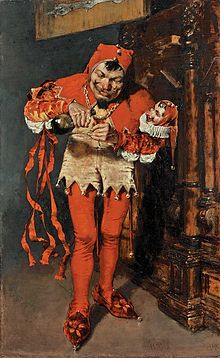
As Purim approaches, I sat down and arranged a recording of a tune to the piyut “Kichlos Yeini”. As you can read here, this is a short song often assumed to be the work of Shlomo ibn Gabirol, the 11th century Spanish Paytan. The author was invited for a meal at his friend Moshe’s home and when the wine ran out he was served water. In jest (or anger) he writes this song that seems to deride and even curse the friend.
The tradition to sing it on Purim lends itself to the idea that it is all in jest.
Ultimately, there is no overt religious message to the poem. This itself is not odd, as many of the Paytanim in the Moslem lands had written seemingly secular poems, as were popular. Some of them even with erotic or homoerotic themes.
Though, that itself may be shocking, it is likely not more than a popular art form.
Important to note, the son of Shmuel Hanagid insisted that every word of his father’s poetry was directed at G-d and an expression of his holy love for the Divine. (Diwan Samuel, quoted in Kramer, Joel L. Maimonedes; The Life and World of Civilizations Greatest Minds. New York: Doubleday. 2008 Ch. 2, fn. 55)Similar to the theme of Shir HaShirim, where we are quite comfortable with the use of a Moshol.
Was this meant to be lighthearted fun, or does it have another, deeper meaning?
On the one hand, it has been printed with Purim songs, on the other hand, the very fact that it has been found in siddurim – and not just collections of poems may imply a religious overtone.
In any case, what I find fascinating is that although this has not been widely published in recent centuries, the tune has survived in several families! The tune I had recorded this week (click here) was shared with me by a good friend, a grandchild of Dr. Benno Heinemann z’l. (Dr. Heinemann is known to many through his English translation of the parables of the Dubno Maggid). This is the tune his family has preserved. In order to preserve it, the family has it printed in the benchers that they give out at family weddings.
The version they insert has the familiar typeface belonging to Roedelheim siddurim. Nevertheless, it does not appear in the Roedelheim Siddur, Baer, or even in a small booklet called “Seder Purim” printed by Heidenheim. So it remains unsolved, just which Roedelheim publication ever had this.
Happy Purim.
(Several years ago I arranged the recording of another tune for Kchlos Yeini. See here.)
 schuster's hall
Wonderful
Can you please attach a printable copy of the text
Purim Sameach
Thank you
HNL
LikeLike
Here it is in a printable form: https://docs.google.com/document/d/184QFPsv3KlWfdUivEVi1S8CIddbRsuz1cRI2sBGvsYo/edit?usp=sharing
LikeLike