Here we will be social. We will share memories and experiences. We do not come here to vent or bash- just to schmooze…and enjoy the cookie parade.
Content will be uploaded regularly and reader submissions will be enjoyed.
All the Best!
Here we will be social. We will share memories and experiences. We do not come here to vent or bash- just to schmooze…and enjoy the cookie parade.
Content will be uploaded regularly and reader submissions will be enjoyed.
All the Best!

We always sat in the back of Shul. It was our seat from a generation that long preceded mine. It was my father’s seat from when he and his good friends Eli Hirsch and Eddie Gutmann were single. Later, they sat together when their families were young. Dad always said that once a week we sit at the front of the Shul. When the congregation does an “about face” for the recital of Bo’i V’eshalom.
Pacing the back of the Shul, one finds a plaque unlike those regularly found in Shuls. “Our Members in the Armed Forces.” This plaque has the names of all the enlisted men of the Kehilla in the Second World War. Once, it was a felt board behind glass until the Jewish Heritage Museum convinced someone to donate our memorial and replaced it with a heavy bronze plaque. You all know this.
(I am entirely certain that had not the name “Henry Kissinger” been on that board, the museum would not have asked for it.)
Anyhooooow, in the four-plus decades that I have been aware of that plaque, it did not ever cross my mind to ask who the one soldier with a star by his name was. The name reads “Erich Goldschmidt”, and the star indicates that he fell in battle. (It says that on the plaque.)
Who was the lone fallen soldier of our Kehilla?
Before we talk about this, I want to note that while KAJ had one fallen soldier, Ahavath Torah (Lieber’s) had three, Sharei Hatikvah had four, and Beth Hillel had nine! Also worth noting that in the lobby of the original KAJ in Frankfurt, there was a large plaque from the First World War with about 50 or 60 names. These were not the names of the men enlisted, but – G-d spare us- those that fell!

I did a bit of asking around and discovered that Erich (Yitzchok) Goldschmidt z’l was the son of Leo Goldschmidt and the brother of Gus Goldschmidt, a well-known member of the community. As you can see on the plaque, Gus, Erich, and a third brother, Karl, were all enlisted at that time. Erich, however, was sent to the front, served as a “Ritchie Boy” (a German-speaking Jewish refugee used in intelligence operations and interrogations), and perished in March of 1945, just two months short of VE-Day- when his unit went over a land mine. Erich is buried in our cemetery, with his military unit prominently listed on his stone. To his family, though, his greatest legacy lies in his reputation for keeping all the Mitzvos, including Kashrus, while deployed to the front.
The Goldschmidt family came from Frankfurt, and all three brothers went to the Hirsch Realschule. Leo, their father, who lived out his days in Washington Heights, was married to Theresa Eisemann. She and her two sisters would sit next to Rebetzin Breuer when they came to Breuers, and I assume they were Mishpocho- although the Rebbetzin was born Eisenmann and they were Eisemann.
During the war, Theresa, her husband, and her sons were split up. Leo was in Scandinavia, Theresa was taken to the French labor camp in Gurs, and the boys were in Saint Cyprien. By a nothing-short-of-a-miracle, the boys were later transferred to Gurs. Then, in a very rare turn of events, Theresa’s brother Gustave Eisemann, who had immigrated to the US many years earlier and established clout and capital, was able to arrange their release from Gurs and arrival in America just a few months shy of the liquidation of that camp to Auschwitz. (Gustave Eisemann was an important donor and builder of the Breuer’s Shul in the years of its construction, and deserves an article of his own.)
This background (laid out in greater detail in the chapter attached HERE, with the family’s permission) should bring the life and memory of this soldier to new light.
His family lost him just as they narrowly escaped the jaws of death; as they struggled to make life anew in a new country; as they crowded into an apartment; as they waited to be reunited with their father; as they took jobs to support themselves with dignity. Then, as the journey neared its conclusion, they would yet need to part with the brave and pious Erich: Yitzchok ben Hechover Moshe Yehudah z’l. That is the story behind the name with a star.
A year later, one day past the first Yahrzeit, Gus had a son whom he named Eric, who still wears his uncle’s Tefillin daily at the early Minyan in the Young Israel of Scarsdale. Gus’s daughter, Debbie, received Erich’s Tanach, and this year she gifted it to her granddaughter on the occasion of her Bat Mitzvah. The family observes Erich’s Yahrzeit, and his name is not lost upon their new generations.
Just as it is not lost upon those who stroll the rear of our Shul.
Zichrono Levracha.

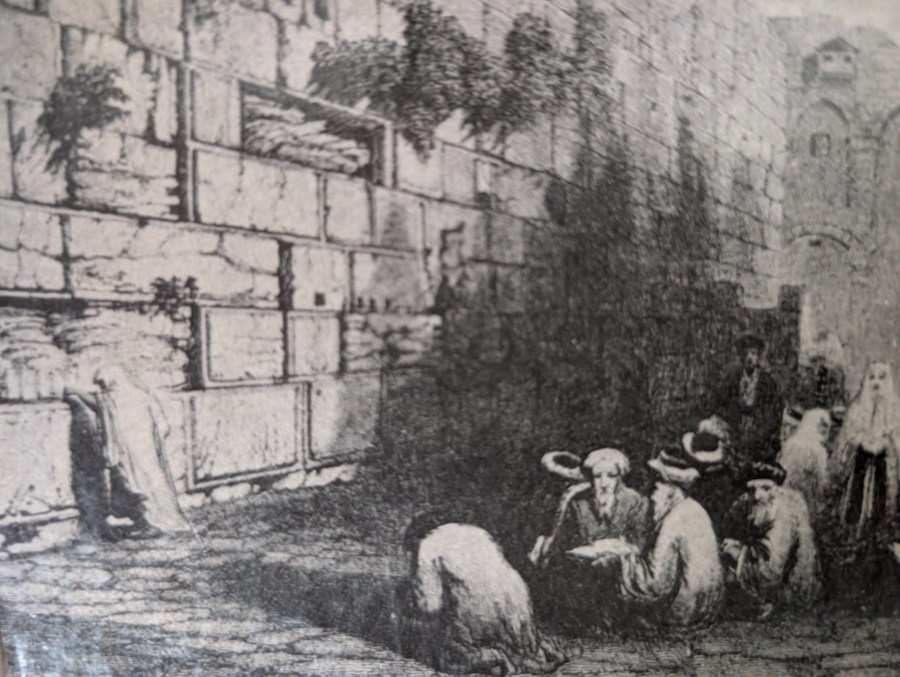
Reader advisory: Extreme sentimentalism.
The old Kinah will be put back on the high shelf in about an hour from now. The Chinuch Atzmai receipts still inside, my father’s calligraphy in the inside cover- likely drawn to pass the time one Tisha B’av morning in 1962. The baroque-ish chants of yesterday’s Kinos still echoing in my head. The monotone leining that still brings the voice of Mr. Walter Schnerb to mind; for some of you, it might bring older voices to mind. Yes, the pews are fewer, but the tunes are as old as ever.
If this Kinah could talk. Yet it does. “This Kinah is inscribed Shlomo Gibriol in its final verses, and was written for the decree of Tatnu.” “This Kinah is inscribed Rabi Meir Malei Davar, and follows the double alphabetic pattern.” “This Kinah is reportedly written by Maharam Rottenburg, and describes the burning of the Talmud”
Ok, dear Kinah, I will step into the shoes (or sneakers) of my ancestor in the Rhineland, and cry one for the Mainz crusade, for the Wurzburg massacre, for the Place de Greve burning, for the city of Frankfurt, for the city of Vermaysa (Worms), for the death of Yohayakim, and finally, in the last hour, in the approximately 10 Kinos that begin with the word “Tzion”, following the lead of Kinah 46, which the Kinah book tells me is from the pen of “Elazar the small and contrite” the author of the Sefer Roke’ach – I will address the city of Jerusalem herself.
“Tzion! Do you not inquire after the welfare of your abandoned?”
“Tzion which was triumphant, perfect in beauty, rejoiced, delighted, elated – the drums of your Cherubs!”
“Tzion! Give weep, give thyself no rest, scream and bend to the ground, for the plunder of your princes!”
The meter follows through all of these- two movements and one peg. Two movements and one peg.
And we sit. The Klugmanns, the Meyers, the Gutmanns, and the Wimphheimers. The Sommers, and the Hellmanns. Whatever is left of us, we sit. And we trod through, and even trample through, the meters. Two movements and a peg. Two movements and a peg. The way we have done this since the days of the Rhineland.
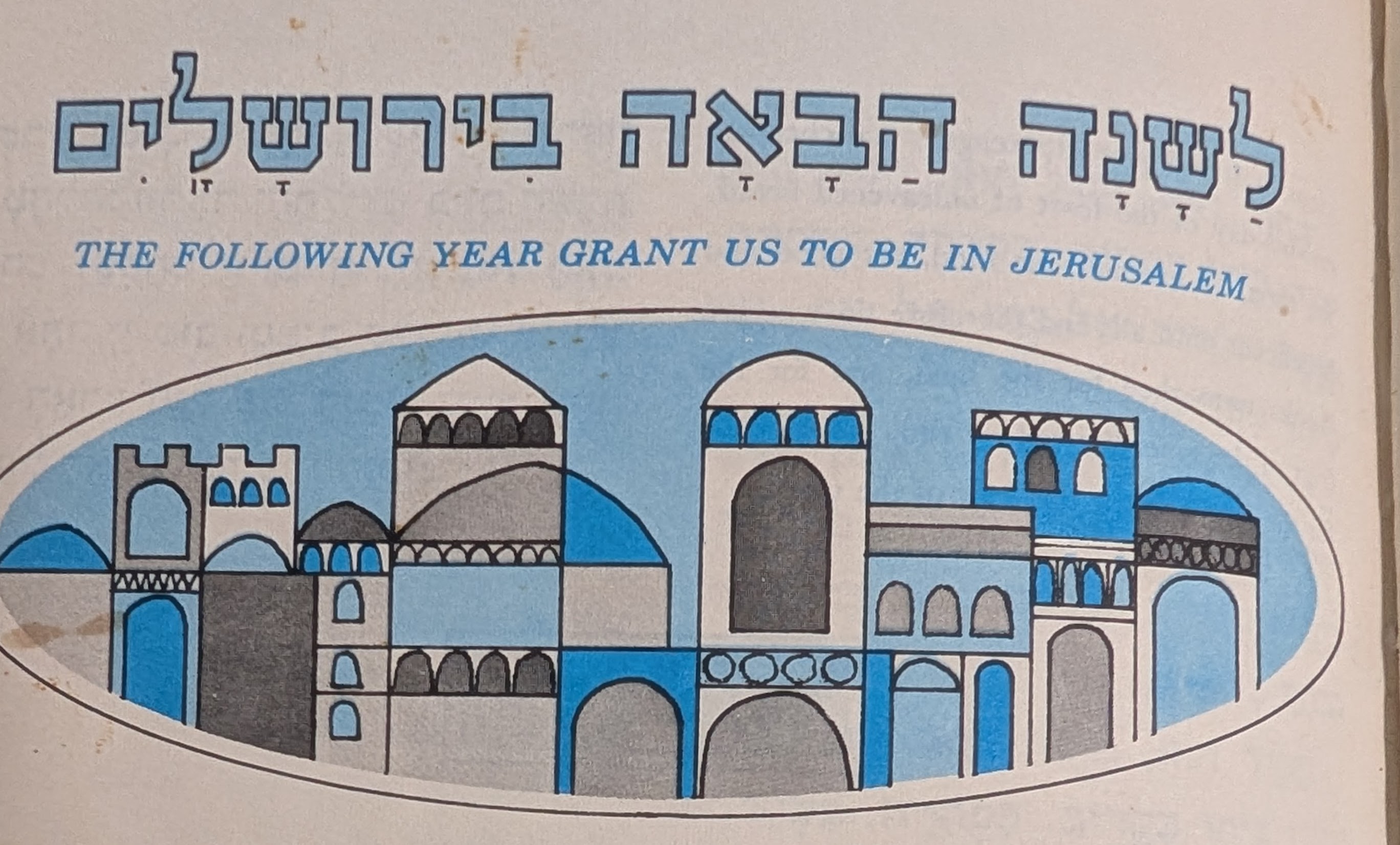
Leshanah Haba’ah B’Yerushalayim.

I was recently strolling through the aisles in Shoprite and I found a piece of my youth.
When I was young and innocent (stupid), my father z’l was once on patrol with the Auxiliary Police in Ft. Tryon Park. The owner of the Green Leaf Café was chatting with him and mentioned that he needed some teenagers to work his hot dog carts on Sundays. My father was proud to offer my services and told me to show up the next Sunday.
Sunday came, I skipped school and headed up to the park and manned a hot dog cart for several hours. Of course, I didn’t eat anything, and it was difficult doling out those great-smelling wieners all afternoon. One option you have on a Sabrett cart is to have Spanish Onions thrown over your hot dog. And boy did those smell good!
Now, Sabrett, the company with the carts, is selling this sweet concoction in a jar (see picture) with a Hechsher, and the calorie/sugar counts are reasonable, too.

Anyhow, my job at the cart lasted only one week, as a senior matron of the community saw me in the park and reported it to Rabbi Stern, who explained to me many Halachic complications that could arise from the situation, as well as the importance of coming to school.
Another job I held as an adolescent was as a late-night waiter at Honey G.’s restaurant, “My Place,” on Amsterdam Avenue. (BTW, see my post here for some real Amsterdam Avenue nostalgia.) My best friend Samson would work there from 6- 9 p.m. on weeknights, and I would work 9-12. We made three dollars an hour plus tips. My shift had far fewer customers (and tips), but was easier and left more room to get to know them. The cook would leave at 10, and then the waiters would run the grill as well.
Someone told me that in the old days, when the Mikveh was on Audubon Avenue, many husbands could be seen eating pizza alone at Chopsies while waiting to walk their spouses home.
As a kid, I would occasionally have dinner in the YU cafeteria. But I was never taken to the place called “Greasy Spoons”. (Its actual name was “Tov Me’od”.) In fact, I don’t even remember hearing about it until the time that someone drove by (1983, see article HERE )and shot bullets through the storefront, prompting YU to partially close the Avenue and build up the security around the Yeshivah.
Growing up on top of Wadsworth Avenue – long after most of the Kehilla was on Bennett or west thereof- was an experience I hope to write about in the future. If you are at all interested, some years ago I wrote a whole blog about our building: someoneoncelivedhere.wordpress.com . I only wish my mother a’H would have lived to see how many young couples would repopulate our area and Wadsworth Terrace.
The year was 1974. I was just a baby, and my father left his job working for a GM dealership because commissions were too low and his boss was giving up the place.
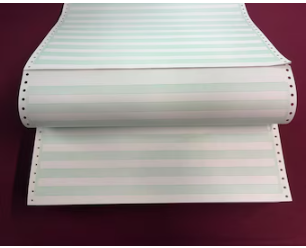
As he looked for other work, his friend Jerry Bechhofer hired him as a messenger at his computer processing business. (To explain to a younger audience: Before every business had a computer, they would send their bookkeeping files to be entered into a computer, and they would receive large printouts on computer paper ( many pages attached with a perforation between each page and holes on both sides to move it through the printer). It often had green and white stripes in the background. See picture)
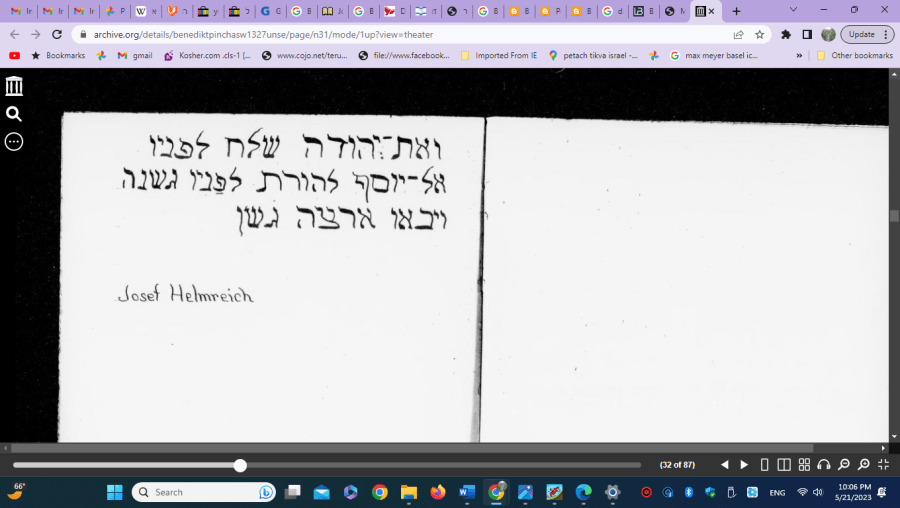
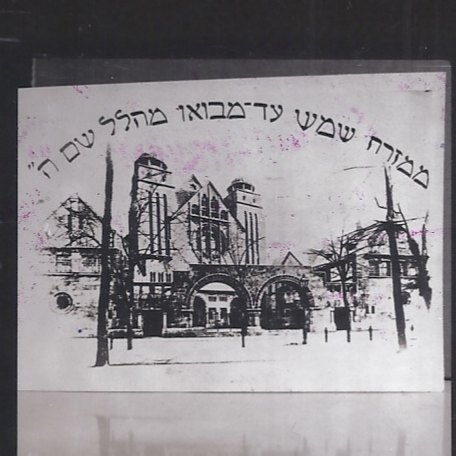
Anyhoooow, he was often in the “apartment”, the home of Jerry and his FIL, the Rav, picking up or dropping off, and if he saw something interesting, he might take a picture of it. One such picture is of the Shul at Friedberg Anlage, with the verse “M’mizrach Shemesh Ad Mevo’o” above it.
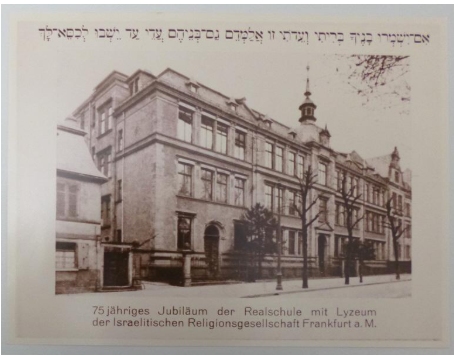
This week, the Jewish Museum in Berlin added a picture of the Hirsch Realschule to its website, which was a print issued by the school to mark its 75th anniversary. The photo has a verse from Tehillim atop the Shul.
I have likewise seen, among family papers, a card my aunt wrote as an adolescent to her brother, with a verse from Mishlei and a picture of herself.
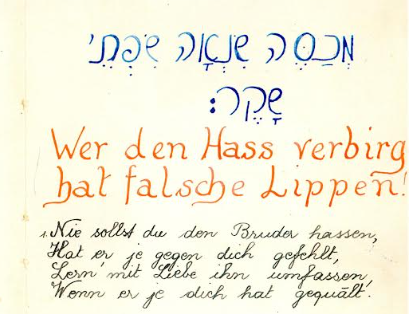
I have seen similar cards on the Leo Baeck Institute website, where students at a German Jewish school created a farewell booklet for a beloved teacher upon his retirement. Many of these cards included a favorite verse, written clearly and sometimes translated.
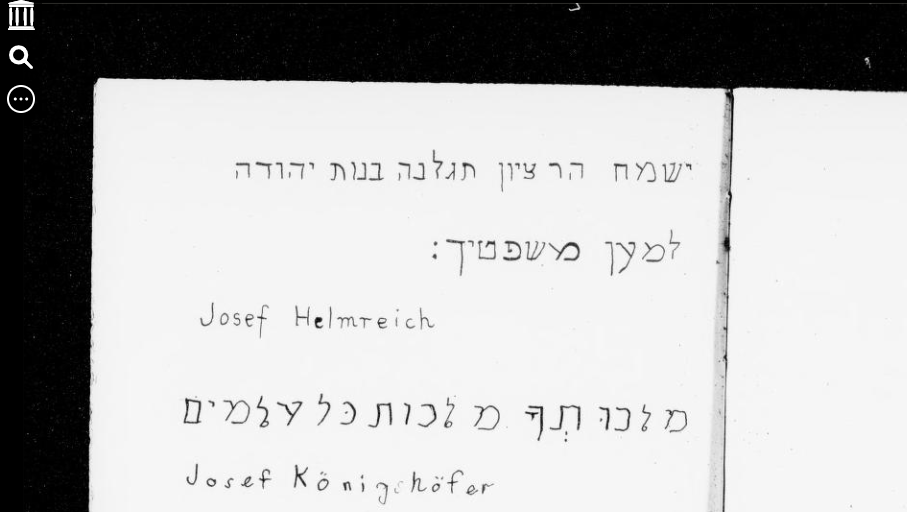
So, there is a lost art that seems to have once been something we aspired to. The ability to quote scripture. Appropriately, artfully.
Tonight I made Havdalah and used up a bottle of grape juice containing a drop of wine saved from the previous year.
Allow me to explain.
At the Seder, we all pour a fifth cup, which is designated as Eliyahu’s cup. Since no one drinks it, it is poured back into the bottle and then is used for kiddish the next morning. At least that is what we did.
About 2 years ago, I had the bright idea to keep the wine from the bottle containing Elija’s cup, keep adding to it, and use the bottle throughout the year. Now, a year later, we have been drinking from Elija’s cup for a whole year. Is it a Segula? I don’t know, but it made for a conversation piece at the Shabbos table and perhaps gave hope to those who drank from it.
Shabbos Hagadol just passed, and this year I feel the name “Hagadol” comes from the Haftorah, where the Pasuk declaring the eventual arrival of Elijah mentions the “Yom Hagadol VeHanorah”.
On the subject of this Pasuk, Elijah’s name is written without the “Vav” in this particular verse. Rashi notes that there are five places where his name appears with the final Vav missing, and, correspondingly, five places where Yaakov’s name is written with a Vav. This is a “security” that our forefather has taken to ensure that Elijah will indeed come one day, on that “great” day.
True to form, our great siddur-master, Wolf Heidenheim, has Eliyahu’s name written without the Vav in every prayer that derives from that final verse in Micah:
Namely in the Bentchen: “Horachaman Hu yishlach lanu es ELIYAH Hanavi…”
And in the after-Brachos of the Haftorah: “Samchenu Hashem Elokeinu B’ELIYAH Hanavi Avdecha…”
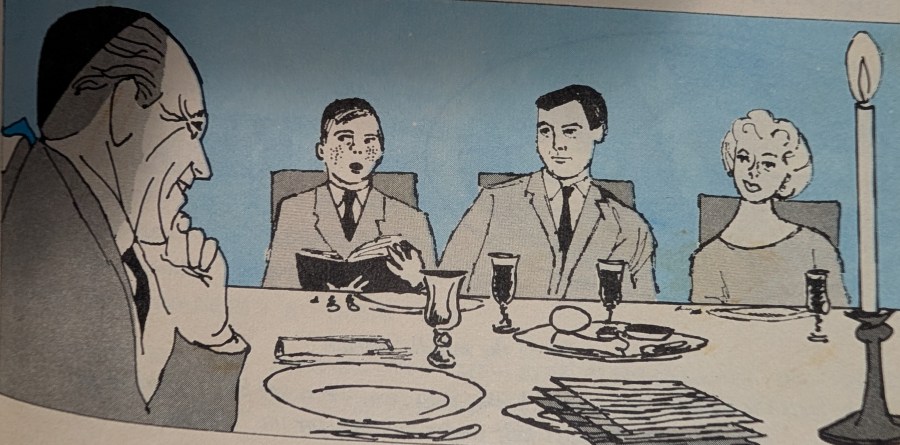
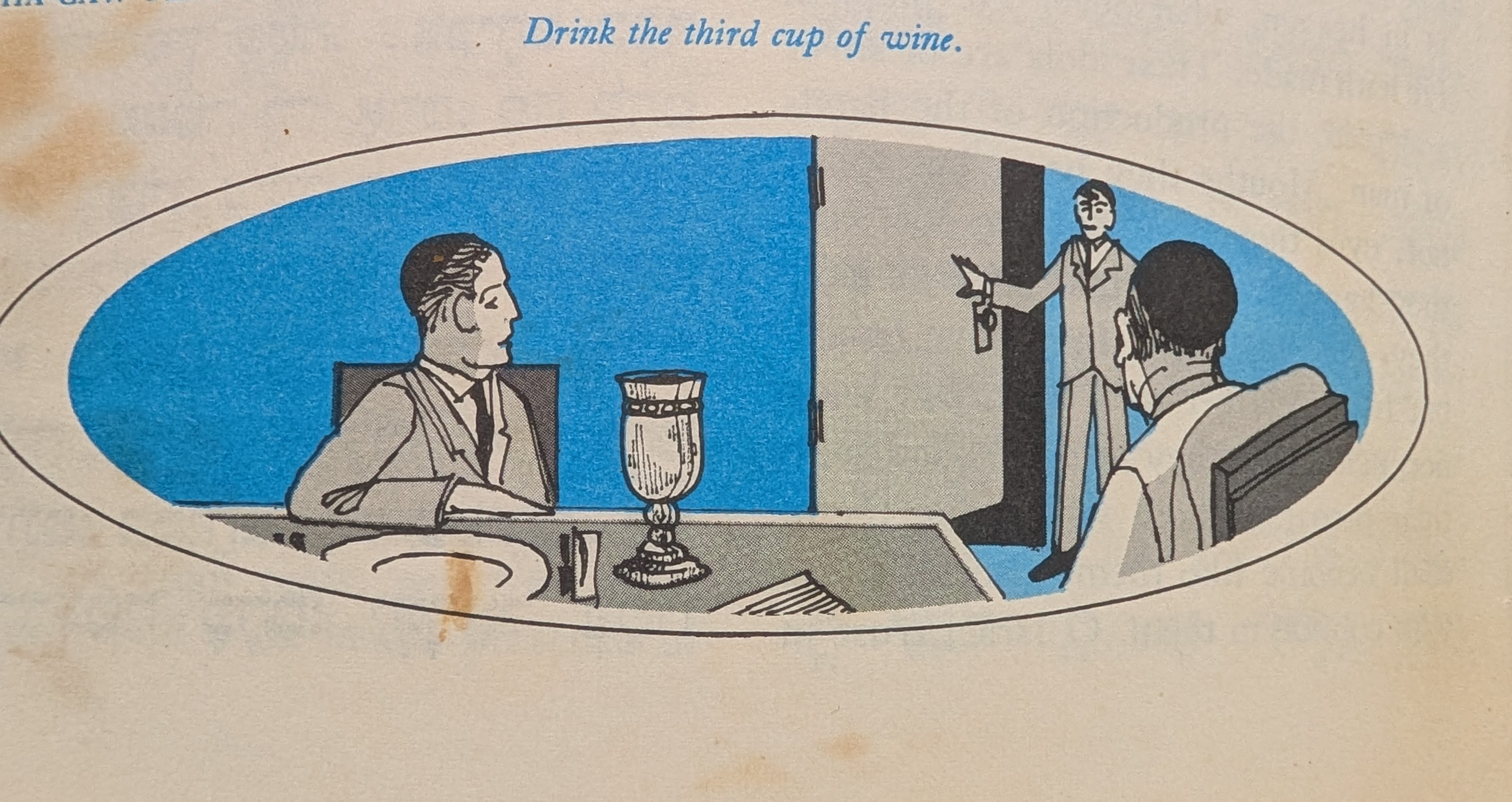
Finally, a childhood memory. The Maxwell House Hagadah and some others, which relied heavily on 1950s-style illustrations, were really the drivers of my imagination. The men in the pictures had such important square-jawed faces with large Yarmulkas as they turned their attention toward the open door. One Hagadah even had a biblical Elijah entering in a cloud of smoke. Oh! The Excitement!
Let me end with a link to a most spectacular new resource I am posting online. It is the history documented by a sweet and sincere man, Mr. Bruno Stern, who wrote two books in his lifetime about his hometown of Niederstetten and German-Jewish life in America. More Here.
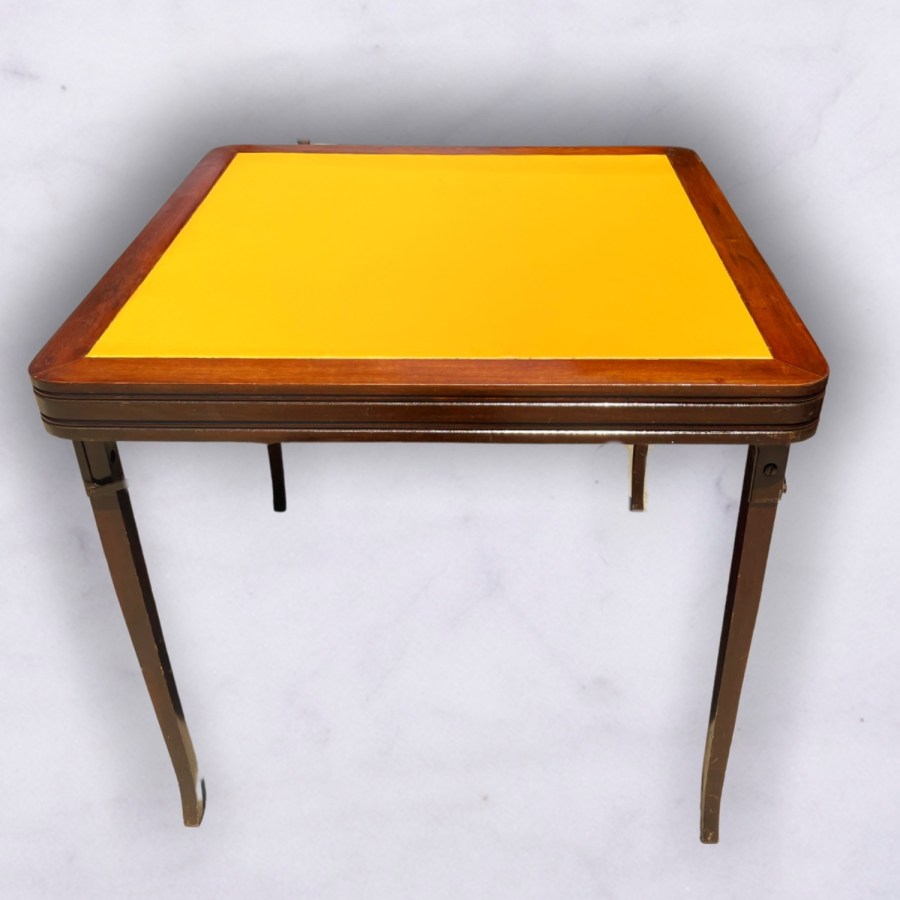
I recently had a memory of how many of our neighbors in 615 had a card table tucked away in a closet or behind a couch. Mostly Sharei Hatikvah people, but I am sure some Breuers people were card players as well. The table’s legs would fold under, and often a chessboard was part of the laminated surface. If we had occasion to borrow one of these from a neighbor, we knew we had to return it before a specific night. (Now, I had an aunt from my Polish side who was a big card player, but she just played at the kitchen table; she didn’t have one of these diddys.)
Another, perhaps more polished artifact of the homes we knew, was the Shabbos Lamp. I do not need to inform anyone reading this about this item, only that my father always wished he had one. He would reminisce about the one in his parents’ home, which – it seems was only used on Sukkos for some reason (this sounds extremely dangerous!)
In the early 2000s, I met someone who told me his father brought the family lamp with him on a business trip to China. He had 100 copies made and sold them for $100 each. Don’t worry, he didn’t ruin the market. Because they were not made of fine brass, but heavy metal painted in black or copper. I know, because I had my mother buy one for my father, and it weighs a ton. We revealed to my father the lamp’s inauthenticity, but he was proud of it just the same.
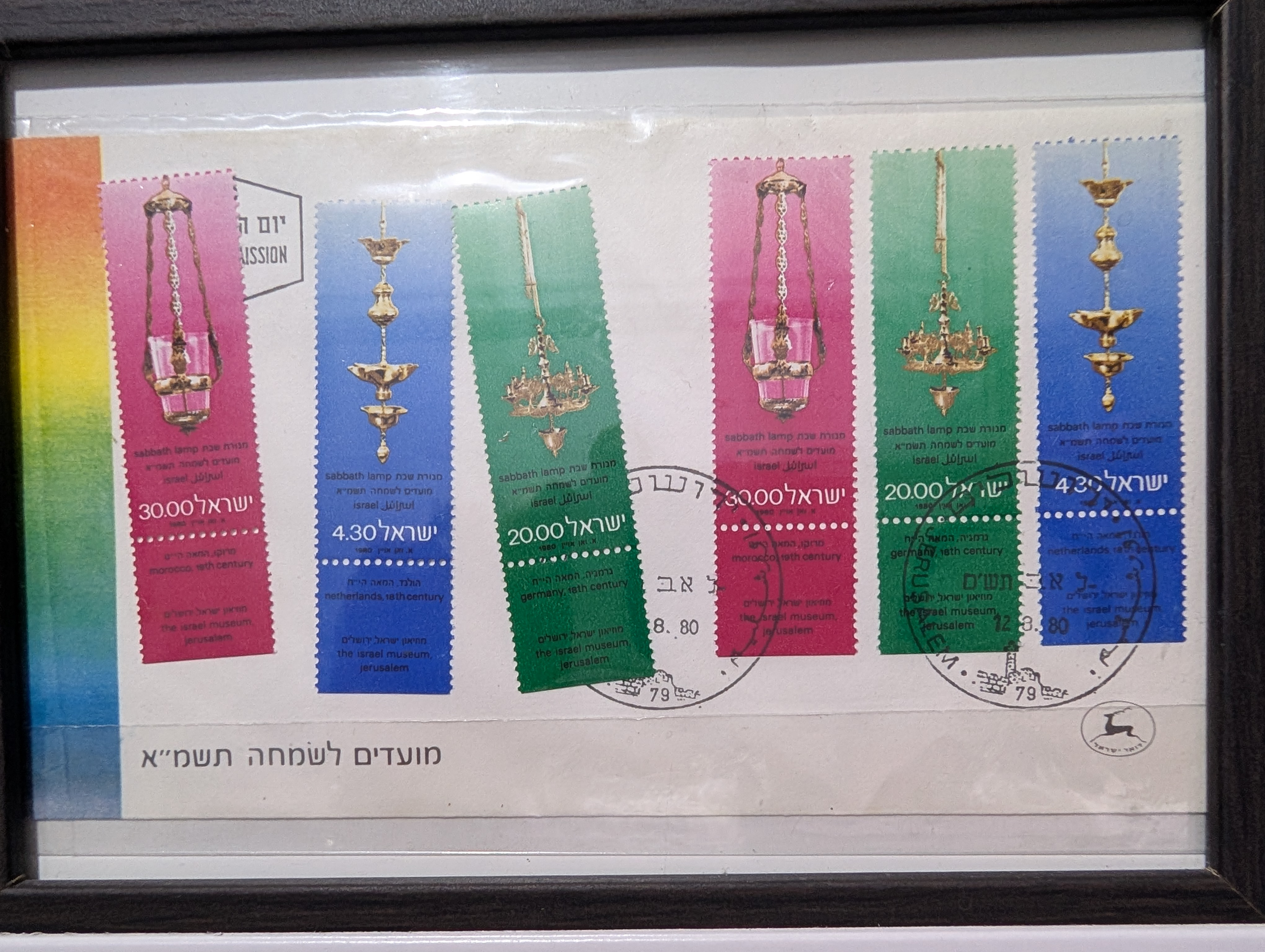
A series of Juden Stern stamps issued in Israel in 1981.
Now, a minute to reflect on the Besomim spice box. I know that all Jewish homes have one, but I also feel like the tower-with-a-flag box has a connection to us. Why? Because the famed Jewish painter, Moritz Daniel Oppenheim, would paint one into each depiction of the Jewish home. That and a Mizrach sign.
Are the Mizrach signs a particularly Yekkish home adornment? I would be naive to think so. But I suspect they are ubiquitous in our homes and appear only occasionally in others. Excuse my myopia.
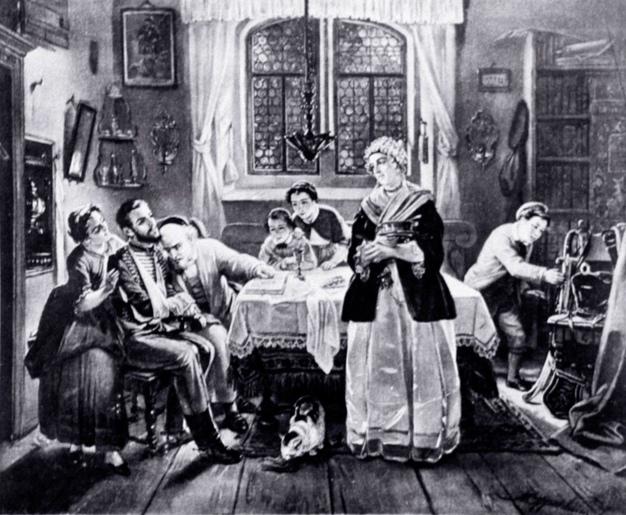
But the Parshah signs are DEFINITELY ours, and ours alone. Again, this needs no explanation (see the picture) because they seem to be a staple. What needs explaining is why we have these? I believe it is a way to bring the Synagogue into the home. Something to change before Shabbos, like a Shammas would need to do in his Shul. I like to do it. We all like to do it. And the KAJ newsletter regularly has them for sale at the Shul office.
.
And that’s what I wanted to get to…
Every time I drive there, I know that this was Dad’s route during the years he worked for Bobby. I ordered one of his standards: apple strudel and coffee. (The strudel has changed.) Dad made his coffee extremely light and sugary, while mine was Darth Vader.
Anyhow, I assumed that the bakery staff was all new, but while sipping, the woman who was busy stocking the challah shelves strolled by me in a way that I realized she didn’t need to be in the seating area but wanted to catch a glimpse of me. Without any hesitation I said, “You remember my…” And she immediately finished my sentence. “He was such a good person. How is he?” Then corrected herself, “I know, I know…”
They didn’t have any of the (few) original Gruenebaum pastries that day, but the Challahs I brought home were phenomenal — and, believe me, I have shopped at every Brooklyn bakery.
There is a story here. Because Dad z’l would always rave about “Gruenebaum’s Challahs are the best in the world…” The rest of us would roll our eyes when he gave this speech. And – it turns out there is something to it! (I am referring to water Challahs. The egg was good as well, but not something unique.)
Friday after Sukkos, I brought home more of these for Shabbos (I was in Riverdale for a Levaya).
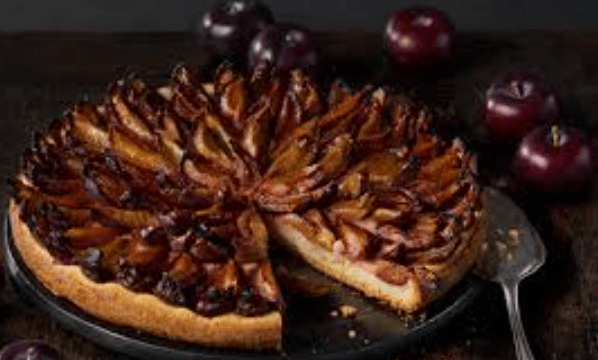
The Shabbos guests were equally impressed with these. I also brought home a ZwetschgenKuchen, which was delicious!
I will add a short story here from my book about my parents, called “Manny and Sylvia” and available on Amazon:
Finally, Grampa retired from the Transit Authority in 1998. This should have introduced an era of relaxation…but it didn’t.
Instead, after a full week at home Grandma couldn’t bear to see him around the apartment all day. It was January and Grampa ran into his old friend Bobby Gruenebaum at the bakery. “What are you doing home?”, Bobby asked. “I retired.” “You retired? So now you’ll come work for me!” And he did -for more than a decade.
There is a backstory here. When Grandma and Grampa were first married, Bobby asked Grampa for a loan, for which he would pay back by letting him take Shabbos challah, coffee and cake throughout the year until it was paid off. Grandma frowned on the terms of the loan, saying, “when you lend cash, you should ask for cash back”. The challahs don’t translate back into money in savings. But this is what Grampa did. This chesed planted seeds that would sprout many years later, as Bobby gave him a job when he needed it most! (Bobby was also a faithful photography customer all through the years, and he hired Grampa for all of his simchas!)
Grampa’s responsibilities at the bakery were varied. He would come at 5 a.m. to light the stove and take challah. He was a mashgiach at the Pesach bakery. He maintained the fleet of trucks and made trips to the bank and post office.
Thank you and Gmar Tov to all who read my things through the year.
One quick note on the Yoim Nora’im.
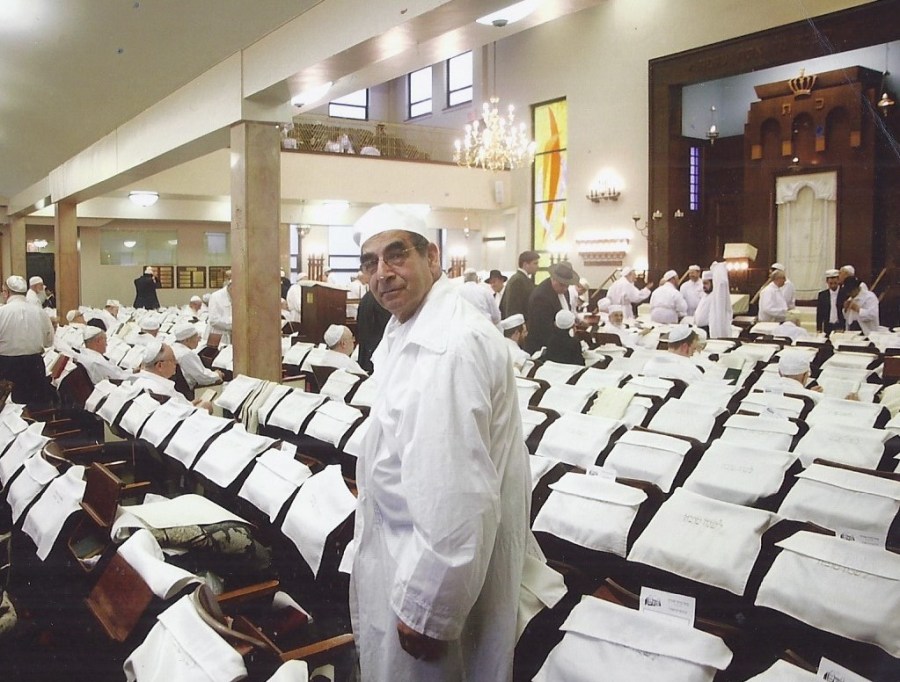
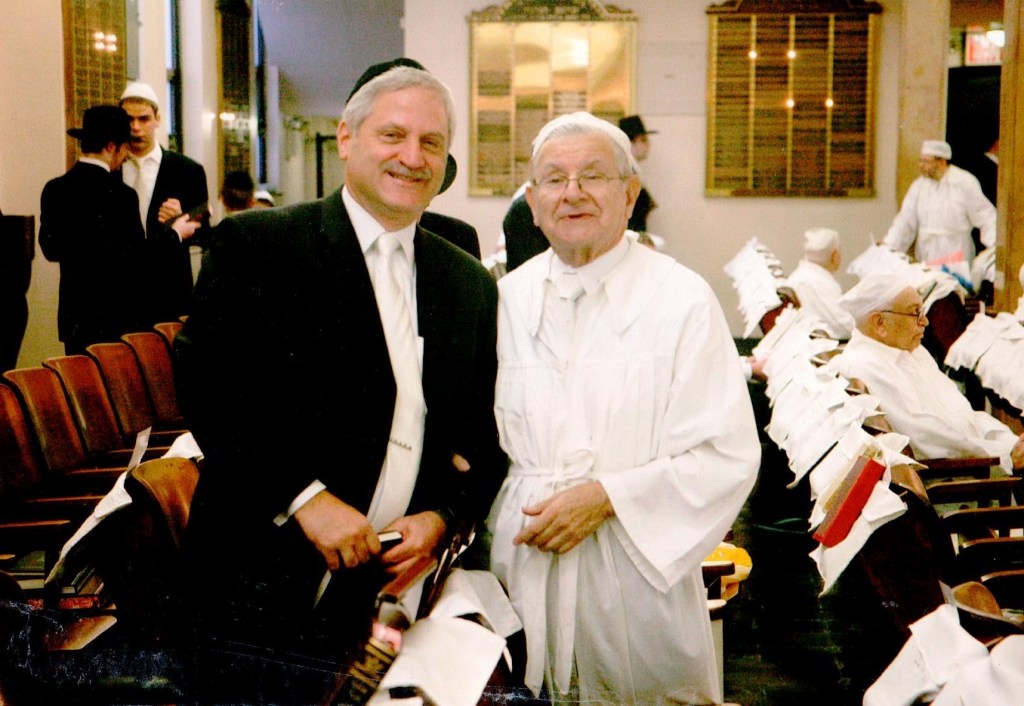
Many of us expatriated Yekkes can showcase our roots at this time through white ties and white Yarmulkas.
Someone in my neighborhood, whose father left the Heights as a teenager, wears his tie and Yarmuka proudly. He turned to me on Rosh Hashanah and asked why my Yarmulka is not white. In turn, I challenged him: “If this is so important to you, why could I not get you to attend our local start-up Yekke minyan even ONCE this whole year?” This ended the conversation. When I later asked him to join us on Shabbos Teshuvah, he had a bunch of excuses. So there are “Yekkes in white-yarmulka only.” (Something like the Kol Nidrei/Neiah Jews who once walked this country.)
Anyhow…in my childhood at KAJ I remember that many men wore a white cloth rabbinic-type Yarmuka that went with their Kittel. Some would just wear a white leather or velvet Yarmulka. Whatever they wore, the standard hat worn for davening was replaced with this Yarmulka.
My close friend, a grandson of Rav Schwab zt’l asked the Rav why we are not wearing a hat on these most holy of days!
Rav Schwab explained that these white head coverings, as they are explicitly worn to enhance Davening, satisfy the requirement for a special head covering.
I do not know if his answer “covers” the regular white Yarmulkas, or just the rabbinic type beanies that are used only in shul.
(I now explain to people when they talk about Yekkes and white Yarmulkas, that it is not a fashion statement, but a way to Daven- perhaps mimicking the angels who are described as “Ish Lavush Badim”, “the man in white linen”- and it is a replacement of the hat.)
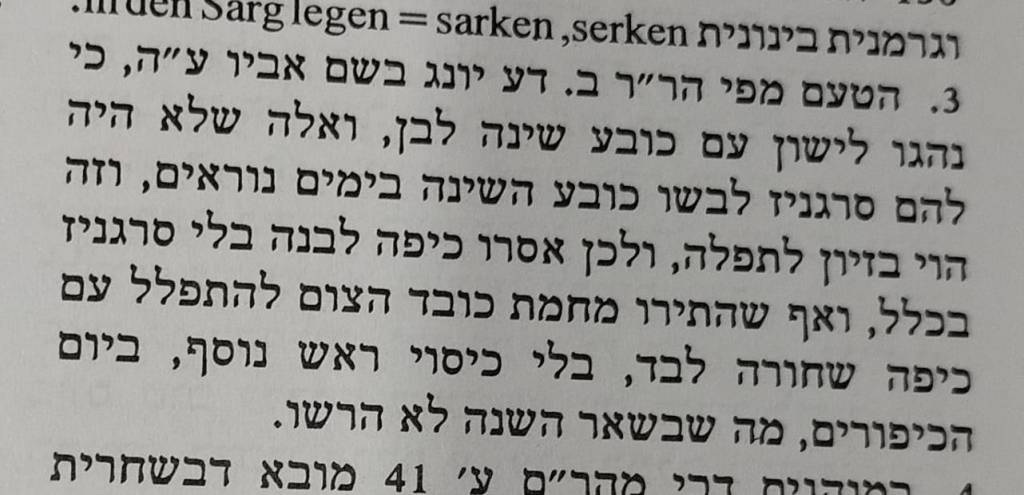
Now, on the much-celebrated Yekke WhatsApp group, my old friend S. Katanka has posted a page from the Minhogim of Amsterdam, where it is stated explicitly that the white Yarmulke, if respectable, replaces the hat. (The author is upset over those who just wore their nightcap to shul!) Clipping below:

“Even on the High Holidays, it is forbidden to wear a white Kipah if it is not a garment of the Saregens”

Among my summer reading was the Dr. Moller bio; see my post (here).
We know, and it is well documented in the book, that Dr. Moller is a descendant of Rav Hirsch zt’l.
Some of the Klugmanns (all of them?) are also descendants.
Finally, there is a Hirsch family in Brooklyn and now Lakewood, with the names Hirsch and Eisenberg, who are direct descendants. (In my extended career as a Yeshivah Bochur, I dated one.)
One of the Brooklyn Hirschs was Naftoli Hirsch, who served on the board of the Jewish Observer. Another member of this family was canonized in a mildly famous story by Rabbi Pesach Krohn.https://aish.com/48906762/
Perhaps, as a community, we have missed out on knowing the “broader family,” and, in truth, some of these families have been separated from our mesorah for several generations already.
It has been suggested that the Breuer and Hirsch families have grown apart over time (besides reasons of geography) because the appointment of Rabbi Shlomo Breuer as a successor to Rav Hirsch in 1888 displaced the Hirsch children from the Frankfurt rabbinate. After the war, these families did not really reconnect in any meaningful way.
In any case, a few months ago, a friend directed my attention to the fact that a Hirsch descendant is buried right here on Ocean Parkway in Brooklyn. The descendant is none other than Rabbi Yeshaya Levy z’l of the age-old Congregation Ohab Zedek on Manhattan’s Upper West Side. Levy was only an associate Rabbi there. The main Rabbi was R’ Phillip Klein z’l, who was married to a daughter of R’ Mendel Hirsch z’l, the son of RSRH, who was once favored for the Frankfurt Rabbinate.
Some material about them is found in the comments section of Kevarim.com :
Rev. Isaiah Levy of the First Hungarian Congregation died at the age of 51, six years after arriving in America. A grandson of Rabbi Samson Raphael Hirsch, famous champion of Orthodoxy in Germany, he was born in London and received his education in Germany. During the war he was a chaplain in the Austrian army.
His brother, Isaac Levy, was a noted dentist in London, who translated Rav Hirsch’s commentary into English. Isaac’s son wrote an interesting memoir which tells much more about the family. There’s No Place Like Jerusalem by Samson Raphael Levy. Rav Shaye Levy was a rav who stood up for what was right and was not a crowd pleaser. He disapproved of the placing of the Amud for the chazan, so when he davened from the amud, he placed a shtender where he thought it belonged. He insisted that his community should have cholov yisrael milk and encouraged one of his children to open a grocery store on the West Side of Manhattan, specifically to provide cholov yisrael products. He was afraid that the long chazonishe davening would cause people to eat before making kiddush, so he made a minyan for shacharis in his home (which continued for many years under the leadership of his son Ellis). His encouragement of kvias ittim LeTorah is found in several published speeches.
More information about Rev Phillip Hillel Klein can be found in the comments on this page: https://kevarim.com/rav-hillel-ha-kohen-klien/

Stone of the Rebbetzin Julie Klein, daughter of Mendel Hirsch z’l/ The inscription mentions in bold how she passed away just two days after her husband!

Anyone who remembers my family will remember that Pesach always meant one of my uncles from Switzerland spending the holiday with us. My father had two brothers who never married. One looked just like my father. He was known for his clown antics but was also very serious and private. The other was lively and talked quickly, but he also suffered from nervousness, which always made his life turbulent. He, too, liked to be funny and had a kind heart. With all of his challenges, he ran a children’s magazine called Kol Hano’ar, which was popular in Switzerland. (My father would receive it and share it with Rav Mantel’s youngest son, who was still a boy when the Rav came to New York.)
The experience was always memorable. Europeans always have an air of sophistication compared to us Americans. Their clothing seemed fine. There was always a hint of cigarette and cologne. Our home was suddenly filled with the Swiss language, coffee was served constantly, and loud conversations—sounding like heated arguments to one who doesn’t speak the language—ensued.
Then came the antics—burping competitions after the meal, silly pranks, funny faces, and my mother chiding her brothers-in-law. Her favorite beef was how they always came with Swiss chocolate bars for me. Since Schmerling was readily available in our local grocery store, she would scold them for their lack of originality. Of course, they were bringing a whole stack of chocolates, much more than we would have bought—so there’s that.
Those uncles have long passed, and my father is not here to fight with them either. Yom Tov will come in with its memories, which the family holds dear and cherishes. The Seder is a link in a chain of Seders past and times separated from us by many Afikomens.
Good Yom Tov!
Featured image available here: ID 53007651 @ Catarchangel | Dreamstime.com

