Some Dinner Stories

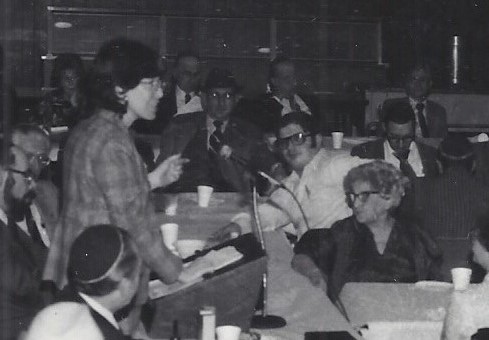
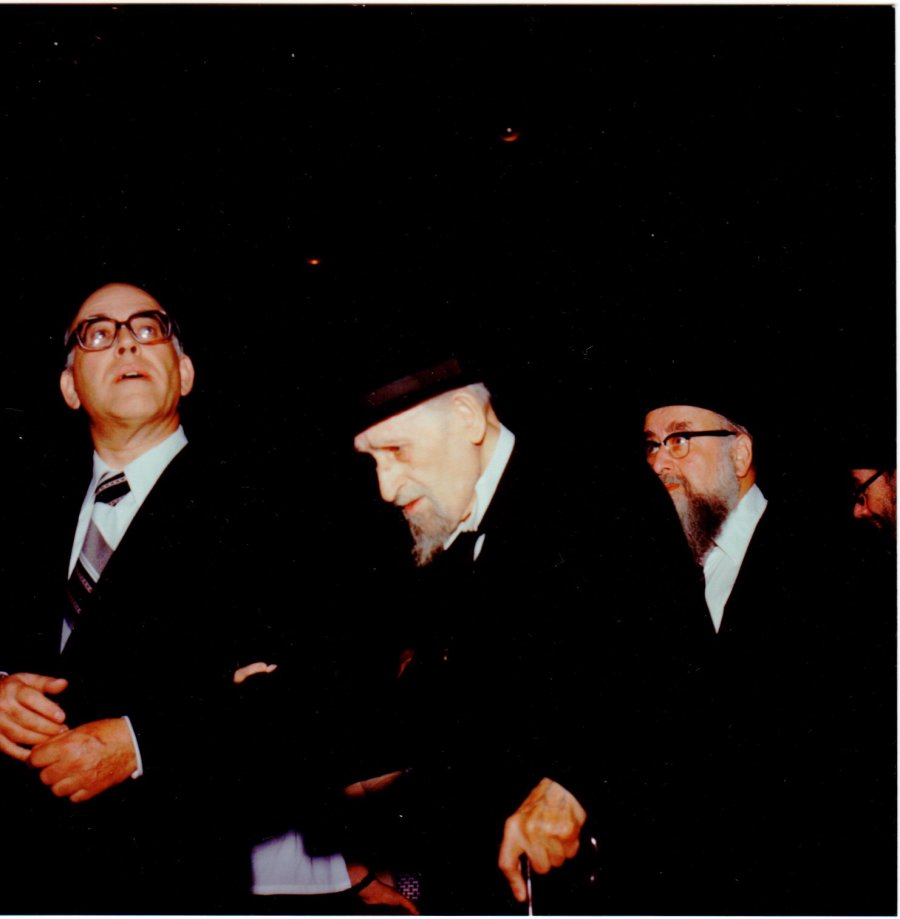
The story behind the picture.


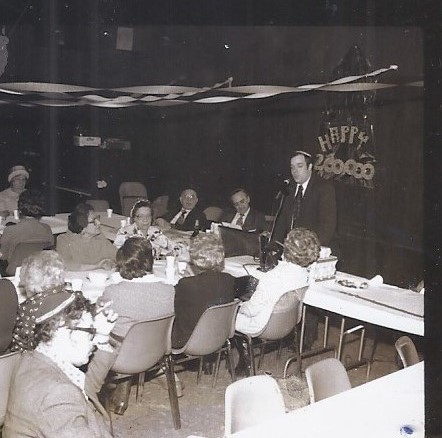
At the annual dinner this week I showed the above photo to comrade Sidney G. and asked him if he remembers that dinner meeting celebrating the 200k mark.


Sidney says that he remembers that the ad that put them over the 200k was solicited by Sonja W. May she rest in peace.

events57

Another picture shows a woman addressing the dinner meeting. Sidney says she was the head of the Bais Medrash committee. Anyone?


Comrade Pinchas K. shared this: One year in the early 60s his grandfather, Manfred zl, was dinner chairman. Now, Mr. K. was a big admirer and supporter of Rav Shlomo Breuer. So…he was used to saying “Rav Breuer sichrono levrocho”. So he gets up to announce him the Rav, (Rabbi Joseph Breuer) and he calls him Rav Breuer Sichrono Levrocho”!!!


The Rav mounts the podium and jokes,” I don’t like to be rushed!”


Pinchas also remembers the first year he and his wife organized the car raffle. They draw the winner and Edwin says to his neighbor on the dais ” I have a funny feeling…” Sure enough the winner is Edwin zl, and this after Pinchas was praised extensively for “arranging” the raffle!


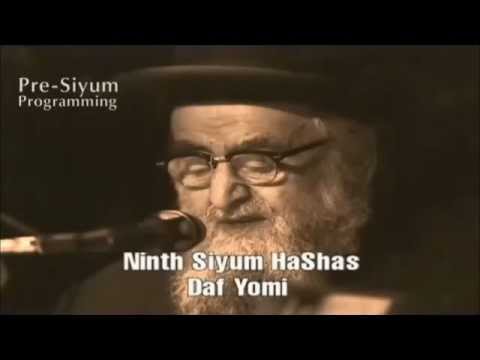
Rav Schwab at the Siyum

As I remember it Rav Schwab was among several speakers, each spoke about the Holocaust. The Siyum HaShas evokes this collective memory sharpest. He told a story that had the whole arena crying. I can’t even repeat it without shaking. (https://youtu.be/lcD2_Qz4qPY)

He also spoke about how he remembers learning a mishna  as a young boy, that tells of  a special bracha for the occasion of seeing 600 thousand Jews at once. He couldn’t fathom even seeing a few thousand Jews together. That night, the first time MSG was procured for the event, he felt a little closer to the dream.

Besides Rav Schwab several others spoke about the level of shechina that resides with 22,000 Jews. This is indicated in the verse (Numb, 10;36) ” Shuva Hashem, rivavos alfei Yisrael” “Return, Hashem, (upon) tens and thousands of Israel.”

I haven’t been to the Siyum since 1991. This year I plan to attend and look forward to it anxiously.

Here is an incredible story. My friend and Partners-in-Torah chavrusah began wearing a kippah a few years ago. Recently, his physician told him that he, too, is Jewish. He also told him that while he does not observe mitzvos at all, he studies Daf Yomi daily and will finish with tomorrow’s cycle! ( He uses the Korein Talmud.)

My friend asked him if he will attend. He said, “No way!”

This should be informative in the way of helping us understand how  much of a divide exists between us and our secular brethren.

The New Rav Schwab Book

There have been some murmurings by friends of mine in the greater Breuers community, both in and out of the Heights, about the newest addition to the Yekke bookshelf. I refer to Rabbi Dr. Chaim Ehrman’s recet work, “ My Rebbe Rav Schwab” (Menucha Publishers, 2019). 


The murmurings are over the inclusion of a section on “Minhagim of KAJ”. The book is written by someone who moved away over 40 years ago, and even when living in the Heights was not a regular at the main minyanim at 85-93. Further, there is no indication that anyone was consulted from within the small group of reliably careful people who have been reviewing and editing copy for the various kehilla publications, or for that matter anyone in the Schwab family.


Now, I have not contacted any Schwab representatives but if you buy the book you will quickly discover that he received a mandate from Rav Schwab z’l to publish his meticulous English notes and even received a nod of approval from the late JGB z’l.


Next, you will notice that the minhag section is light on details. It doesn’t tell you to switch the ma’aravos for the first night of Sukkos or where the chazan begins to read aloud at the end of az yashir. It is rather a loose collection of notes and background on some general guidance he has received regarding minhag and Halacha from the Heights.


Now, speaking as a guilty party myself- for if anyone has written, produced, disseminated, and cyber-ized vast amounts of information and history of our kehilla, without consulting the carefully circumspect inner-circle of auskim betzorchei tzibbur, those who are normally responsible for the veracity and tactful dissemination of kehilla documentation…IT IS I. GUILTY. GUILTY AM I.


So, I take my soiled finger and point at this work and add it to the voices from without. The unofficial biographers. The uncertified and the unauthorized…but the well meaning. We have a voice too. And, alas, we have spoken.

I don’t expect, nor would I want, my content to be treated as seriously as the serious volumes of literature produced by and through the Kehilla and its worthy representatives. The existence of one need not preclude the other, though.


In the spirit of unauthorized biographies, I am turning to my readers and asking them to submit their personal interactions and received Torah of Rav Schwab. I will add some of my own. In the spirit of friendly blogging, I will only publish positive interactions. So if you need to vent, please choose someone else’s platform.


Write away….


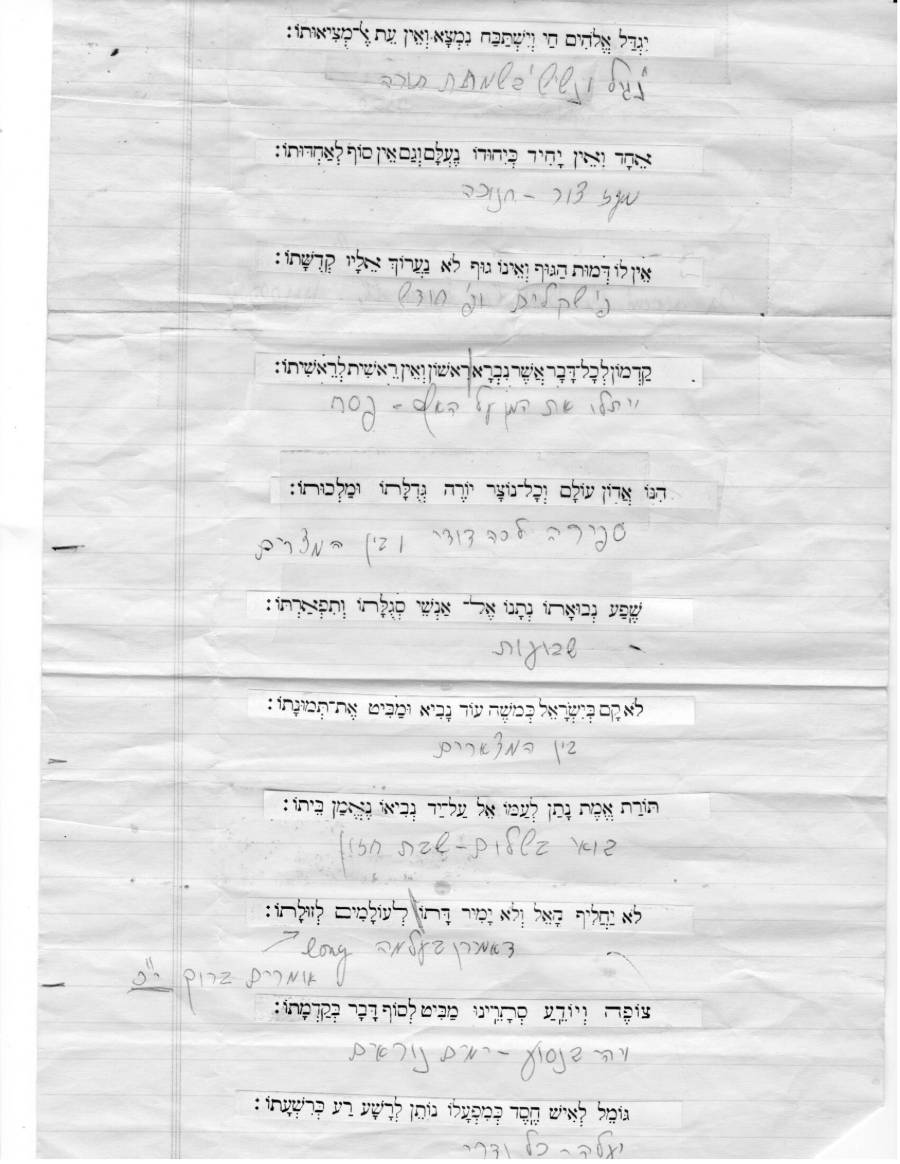
Jahres Yigdal of Moshe Schnerb

Every year, once a year, the jahres yigdal is sung on the festival of Simchas Torah. Jahres refers to the custom of incorporating all the tunes of the yearly cycle into the various tefillos of the day, often by the chazan masterfully switching between tunes of the holidays and such- 


There is a Yigdal sung on the eve of Simchas Torah in Breuer’s that  creatively and seamlessly switches between the tunes, subtly- weaving the motifs into a continuous melody. This jahres Yigdal was composed by the choir leader in Frankfurt, Moshe Schnerb. Moshe Schnerb was the son of Godschaeu or Chaim Gershon Schnerb the well known Chazan and choir leader  of Merzig, originally from Alsace. 


Moshe’s son – Dr. Godscheaux Schnerb was the first choir leader in the Breuer’s shul in New York, and his son Walter succeeded him in this task. 


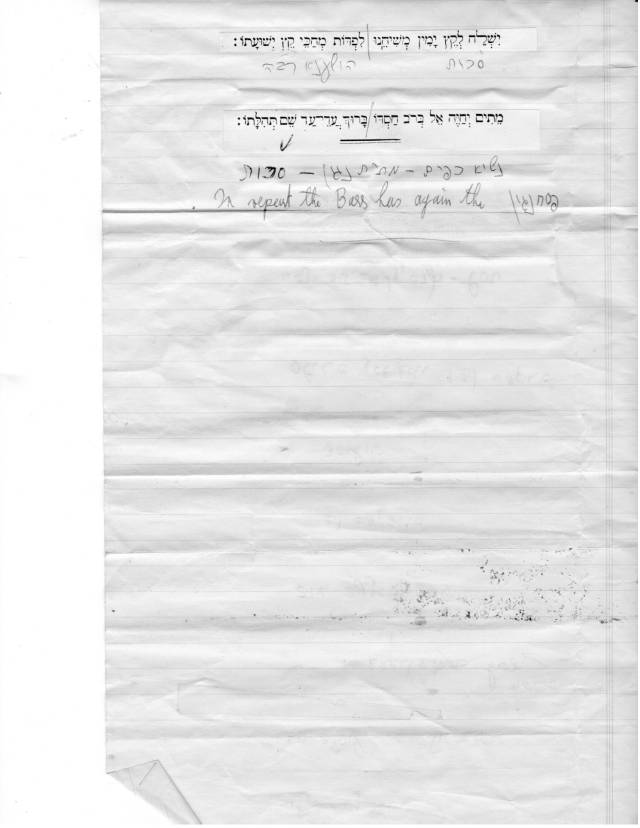
When I was a young adult, I asked MR. Walter Schnerb if he could write out the list of tunes incorporated in the jahres Yigdal. Mr. Schnerb, a skilled bookbinder by profession, took the time to photocopy and cut out the lines of Yigdal from a Roedelheim siddur, and paste them to a paper and write the names of the melodies below each line. 


In the spirit of Jahres the tune flows in the order of the Jewish calendar from Simchas Torah, through the year, and back again to Simchas Torah. In the recorded version presented hereschnerbyigdal-2, the piano intro is taken from maoz tzur. I don’t know whose arrangement that was. 

The Legend of the Rascal

Here is what I sometimes think about since I’ve begun teaching middle school recently.

Do nice guys really come in last?

The nice guy is the one who does everything right all of the time. He plays by the rules and in the end he reaps his reward.

But then there’s the guy who already broke all the rules, but pulls himself together and applies  himself when duty calls.

This “guy” has something the nice guy lacks, and eventually it works to his advantage: The ability to have broken the rules, and to use that same mischievous edge for his own survival, and the good of others one day.

I am writing this now because we are approaching Rosh Hashanah, and I am writing it here, because, on my first trip back to the schoolroom this September, I needed to remind myself of the legends of Washington Heights.  I needed to remember that behind every rowdy boy is a future success.

The legend had it that the worst kids in our Yeshiva grade school, the terrorizers – if you will, grew up to be the most successful. I can think of two in my era, and my mother always talked about the grandson of a board member who was kicked out of the school (or almost was?) And then, as life progressed, some of these children found a way to express this excess energy in a way that no one could have ever foreseen. They wound up making their first million while the nice guys continued punching the clock. Now, success isn’t measured in millions, (or it shouldn’t be,) but you can’t call them  failures either.

I am trying to keep this in mind when mentally evaluating the different boys in the classroom.

I suggest that we take this approach to Teshuvah. And- at the risk of preaching- I suggest that we look at our own shortcomings as our key to our future successes. We can use this for the good, if we just realign our intentions for the Honor of Heaven. Kesiva VeChasima Tova.

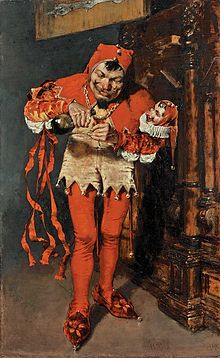
Funny German City Names

I have made aquiantance with a young college/rabbinical student in Berlin. I was picking his brain, and I mentioned that I came across a German city called “Nidah”. I asked him for other funny names of actual cities and he produced a whole list. Find them below…

Muckenloch=gnat hole
Deppendorf= village of idiots
Deppenhausen= house of idiots
Dummersdorf= dumbers village
Kotzen= to puke
Schmedeswurtherwesterdeich= Speaks for itself

(Two more I had to leave out of this post out of good judgement.)

And runners up are:
Windischeschenbach
Bad Gottleuba-Berggießhübel
I will add:
Nekkarbischofsheim

Anyone have a favorite?

Photo: wiki commons. The Court Jester, W.M. Chase

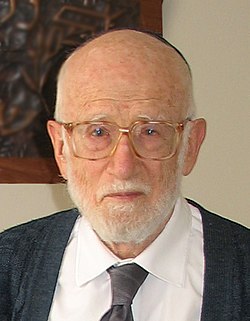
Professor Leo Levi z’l and a Bygone Era

There was once a little street in a small neighborhood on the edge of Jerusalem.On this little street, where trees threw shade on courtyards and alleyways of Jerusalem stone, children played and buses rumbled by a small kiosk across from the Swiss butcher Rosenbaum and a small stationery store where little girls bought pencils for school; and women felt the vegetables at the stoop off the fruit store adjacent to the kiosk where Donny would place a soy frankfurter inside a boureka for three shekel, as Yeshiva students waited and seminary girls picked out a gift for their Shabbos hosts. 

Across from all this stood a tall shul with immaculately shined floors and a view, from between its tall and narrow windows, of the entire center of Jerusalem. But when these windows were closed it was just a neighborhood shul where fathers sat next to sons and older men hushed the children.

On this little street, with the kiosk and the Swiss butcher and the shul and the buses, lived some of the most interesting and prolific writers of the type that contemplate science and Torah with an eye to self-improvement and adherence to the holiness and piety espoused by the Torah sages of every generation.

These men were Rabbi Aryeh Carmell, Professor Cyril Domb and Professor Leo Levi, zichronam levrachah.

I am not going to launch into biographies or eulogies. These men were Heaven-fearing, they were friends, chavrusos , and belonged to an early wave of brave and unique English language Torah purveyors. Two of them were celebrated scientists, founders of the movement of Orthodox Jewish scientists in America and Britain, and eager to apply the Torah perspective to the medium of science. Not looking to disrupt the scientific process, nor apologize to it or for it — but to give a reassuring perspective to the Torah student that science is the study of G-d’s world and Torah is the study of G-d’s word, and one need not fear the existence of the other. Filing through several volumes of their combined works, I do not know if they ever said this in these words, but as sure as they walked the planet this was what they came to proclaim.

In fewer words, they were the purveyors of Torah im Derech Eretz in its rawest form. While we would quicker describe TIDE as the Torah’s relevance to every aspect of our lives, i.e. our day-to-day lives, they looked at the Torah’s relevance to the world we stand upon and the discoveries of those who observe it. (In his work,  Masterplan, Rabbi Carmel espouses the ideas of R.S.R.H.’s Horeb — so there is conventional TIDE here, too.)

On this same bucolic street, reminiscent of something European, lived a saintly chasidic rebbe of advanced age, the Tolner Rebbe, and ybc”l , still lives the great Posek, Rav Azriel Auerbach shlita. Recessed behind that street stands the famed Yeshiva of German rabbinic founding, Kol Torah. And in one of the alleyways resided the early compiler of Hilchos Shabbos, the Berlin-born Rav Yehoshua Yeshayah Neuwirth. Indeed this was a sweet Gan Eden of Torah and Eretz Yisrael, and three men, friends, and co-authors, were among the great adresses on the lane. Now with the passing of Rabbi Prof. Levi, it is a bygone era.

Yehi Zichro Baruch

Rav Breuer Anecdote

Just came from a bris in Lakewood. Rabbi Shelomoh Danziger shlita complimented my bentching. That was worth the whole trip!
He then told me this story…
A Rosh Yeshiva from YU came to visit Rav Breuer Ztl after he had lost his eyesight. The Rav told him, that regardless of the loss of vision he thanks Hashem for what faculties remain.
The Rav went on to interpert the mishna in Avos accordingly:
“Who is a rich man? He who is happy with his “chelek”, his lot. (Chelek could mean something broken off of a whole.) So the mishna means that even if one is left with only a “chelek” a piece of what he once had- is wealthy if he learns to appreciate it.
The visiting Rosh Yeshiva replied in awe: “This is a perush fitting to be said by one of ther Gedolim!” (Unwittingly implying that Rav Breuer was less than that…) And the backhanded compliment evokes smiles to this day…

The Rav Enters.

For the Yahrzeit I am posting an essay. I  have the generous permission of Feldheim Publishers.

I have typed the post below:

Rav Yosef Breuer ZT’L

The Rav Enters

From the book: The Yearning Soul, Rabbi Moshe Einstadter. Feldheim Publishers 1992. Pg. 133

It is so many years ago, and It belongs to a bygone era, but I remember it as vividly as if it were yesterday.


It was several moments before mincha– a late hour at the end of a long summer’s day, or quite early during the winter- and within the next minute or so the Rav would make his entry into shul. Invariably he would allow himself precisely the time it took him to slowly proceed from the door to his seat at the front of the shul, and one or two minutes more for the time it would take him to prepare himself for his encounter with Hahsem Yisbarach. I waited with anticipation, not merely once, but every time, for his entrance filled me with a profound sense of reverence for kedushah and for that which is meaningful in life. And so glancing toward the door from my vantage of the southernmost sea in the back row, I waited.

Presently, the right door of the two southern inside doors opened, and the Rav entered.

I observed him closely. Rav Breuer would first carefully place his walking cane in the rear corner where wall met wall, and then begin his slow and unsteady advance up the aisle.

His dress, just as most everything about him, varied hardly at all. There was the round black hat with the upturned brim; the outmoded early twentieth-century wing collar and black bow tie; and on weekdays, the somber gray vest and three-quarter-length jacket. The sides of his face, in keeping with Germanic custom, were clean-shaven, and a trimmed beard dignified his countenance. He wore wire-frame glasses.

His eyesight was poor and he would move cautiously with faltering step, pausing every so often to steady himself before continuing on. He began the trek with his eyes fixed upon the floor before him, but after every few steps he would raise his head slightly upward, looking into the vacant space that met his glance. It was this look that intrigued me; it was mostly for this that I expectantly waited. It spoke worlds of the man who bore it; it captured a rare and enlightened personality.

Ostensibly, it took in the external world of material substance, but in truth he saw it not at all. It was an inward look, that focused on the true concerns of a lofty mind which oiled with uncompromising dignity in the world of practical reality. Etched into that visage was the register of a lifetime- first the old world,  which had formed and nurtured his Torah world-view, gone and lost beyond recall; and now the present world, into which he had translated the values of the old. There one could see the lines of battle fought and won, the just pride of noble accomplishment, the deep furrows of past sorrow. It was the profoundly serious look of a man of unshakeable faith, whose purpose was firm, whose commitment never wavered, who was tested and found true.


But beyond it all was the immense and unspeakable dignity which radiated from his aspect. If “Panim” in Hebrew, indeed reflects “Pinim”, here was the glorious proof; never to bend, when to bend was weak; yet humbly to bow when it drew from strength; to staunchly maintain the proud heritage of his fathers- a way of life which needed neither apology nor defense; to rise, to grow, undaunted and ready to meet future challenge. It was his shul, his kehillah, born of his vision, his labor, his trust. Elokim Haroeh osi me’odi ad hayom hazeh- He (G-d) had paved the way for him in the past, and He would see him through to the very end.

And thus he made his way very slowly, past one row of seats after another. Some noticed the Rav coming and respectfully rose while he was yet at a distance; others, caught unawares as he passed them, hurriedly rose to their feet and remained standing as he continued slowly on. They rose one after another, old and young, learned and ignorant, in wordless veneration for their revered Rav.

At last he reached the front rows and finally gained his seat. One to two minutes elapsed; then the Shaliach tzibur commenced ashrei.

Whenever on occasion I happen to be in new York City’s upper Manhattan and go to daven mincha at Breuer’s (the institution still bears that name), I occupy the southernmost seat of the back row. Several moments before the start of the tefillah I involuntarily turn and glance to the back door. In my mind’s eye I see a venerable gray-clad figure slowly make his entrance as in days of yore. He passed on to his eternal reward long ago, but his spirit resides within those walls forevermore.
Omer in Rhyme and Song

Many of you are likely in possession of lithographed hagadas of the type produced by the Diskin Orphanage in Jerusalem to solicit donations. (There is no orphanage there anymore, rather they rent out that mighty fortress that they own in the heart of Jerusalem as office space and use the monies and donations for general distribution to the poor (my googling here).

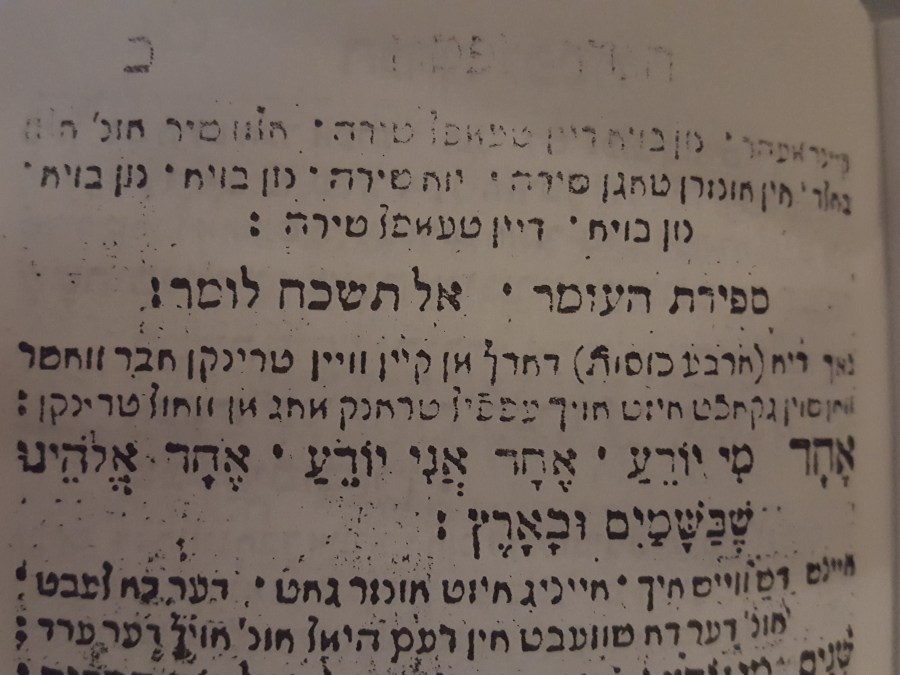
In the Hamburg hagada of the early 19th century, sefiras ha’omer is not included, but in its place is a REMINDER not to forget- in what was likely a humorous and witty rhyme:

Sefiras Ha’omer Al Tishkach Lomer”

Which rhymes if you choose to say “Lomer” in place of “Lo’mar”- which was probably a common corruption in the Judisch-German of the time!

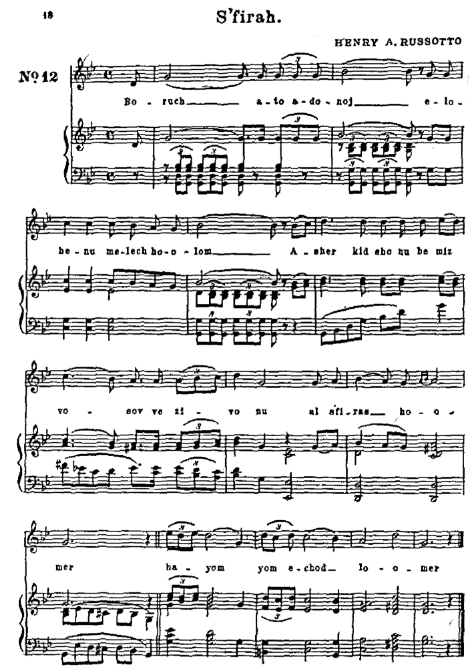
Now to song: On the website of Hagada collector and lecturer Avraham Roos of Amsterdam/ Israel I found sheet music that appeared in early 20th century hagadas. I gave it to my friend to play, and then I faked the chazanus- for the sole purpose of sharing the tune (click here). The arrangement is by Henry A. Russotto who composed and arranged many scores in that era, including a yiddish song about the sinking of the Titanic.

Finally, in Breuer’s the Lecha Dodi for the sefirah is hauntingly baroquish. It is a favorite of mine, and, I am told, that it was originally used for the Three Weeks until it was displaced by the current tune. I don’t have a recording of it, but would like one!


omertune