
Recently, I have been participating in a newly formed Aschkenaz Minyan in the style of our Gemran Mesorah here in Midwood, Brooklyn. The Minyan formed over the summer through the efforts of a good friend- a young man of Lithuanian descent who harbors a thirst for researching and reviving Minhag Aschkenaz through his blog, along with Moshe H. – a KAJMO expatriate who had first hosted the minyan in his home and was later instrumental in finding a dedicated space for the Minyan.
On the last days of Sukkos, the Minyan had all Tefilos, but since then, we have only been meeting for Friday night and Motzi Shabbos. This even though we have a Sefer Torah on loan from Yehudah N. and his family. We intend to meet for Shabbos Mevorchim Shacharis, but this has not materialized yet.
On Sukkos, I had the chance to sit in the Kehillah Sukkah next to Mr. Michael W., who told me he has access to a very old Sefer Torah from Germany that is Pasul beyond repair. I asked if I could borrow it for Hakafos, and he agreed. The Sefer was returned to his father upon the liquidation of Cong. Beth Hillel in the year 2000- although he does not know how his father initially got it to the Shul. The inscription on the Torah was hard to read since the name of the city is not found on any map. The year of its dedication is clearly legible as תרכט= 1869 !! Upon closer look and with the input of Yitzi E. it became apparent that the city is Berlichingen. This city is on a map and is home to a famous medieval knight whose life was memorialized in his autobiography (!) and by the German writer Goethe: Gotz von Berlichingen. Knights and castles aside, the town had a Jewish community dating back to the time when Gotz’s family still governed the district!
The following is from Geni.com
“Jews are first mentioned in records dating from 1632, when the village was ruled by the noble Berlichingen family and the Schoenthal Monastery. The Jews who were permitted to settle in the village were descendants of the Jews expelled from Spain. They were treated well but subject to paying high taxes. The congregation was established in 1632. A cemetery was consecrated that same year and also served the neighboring Jewish communities. Prayers were conducted in a private home; a synagogue was established during the mid-18th century.
The Jews worked as cattle, sheep, and fish merchants, as well as shopkeepers, peddlers, and moneylenders. Others worked as artisans, butchers, and innkeepers. Their activities during this time boosted the village’s economy.
The first rabbi of Berlichingen was Rabbi Jacob Berlinger (served 1809-1834), a descendant of Rabbi Akiva Eiger. During that period Berlichingen was the headquarters of the district rabbinate, which included three other nearby Jewish communities. Later the district rabbinate was moved to Bad Mergentheim. The community was led for many years by Shimon Metzger.
The Jewish population reached its peak in 1854, with 249 people (about 16.3% of the general population) living in the town, as well as a small group of about 50 Jews who lived in neighboring Beiringen. After 1883 the Jewish population declined due to emigration and the rapid urbanization in south Germany during that period. At the turn of the 20th century there were 90 Jews living in Berlichingen.”
Common Jewish surnames in the area were Kaufmann, Metzger, Gottlieb and Berlinger. The latter family produced several well-known rabbis and teachers. (From Allemania-Judaica.de)
The Torah scroll is enormous and was mine to hold as I danced and led the piyut “Besimchas Torah,” whirling in a circle with two other men holding their Torahs and this one retired Sefer Torah. A Torah that may not have had another Simchas Torah if not for our little Minyan.
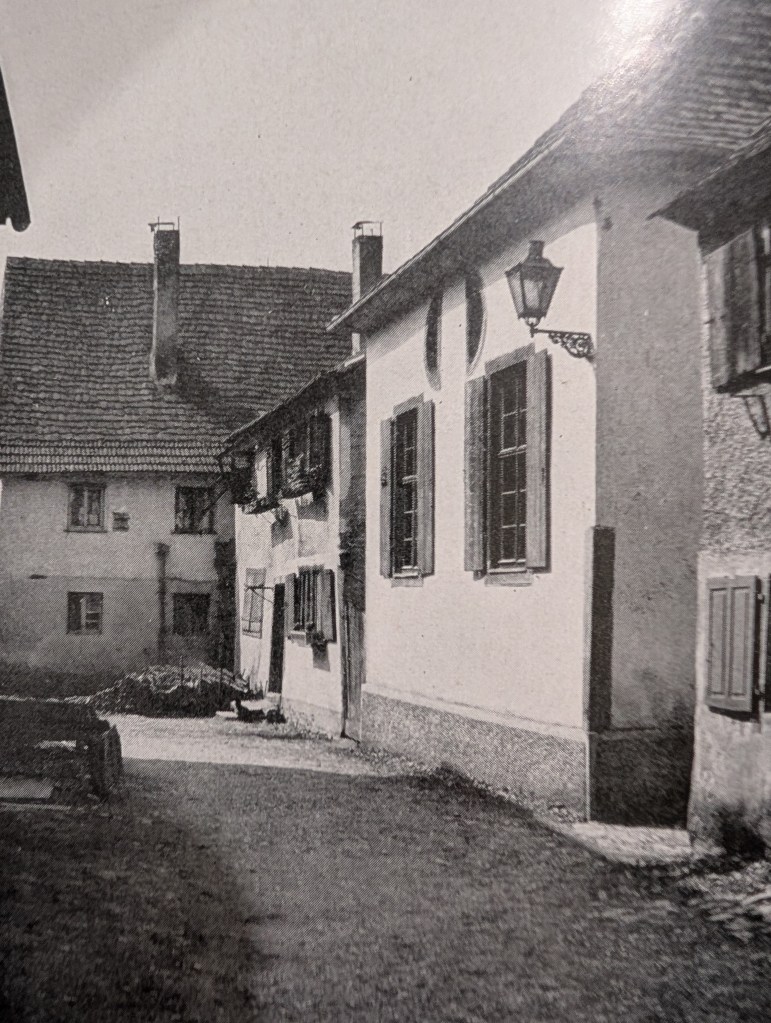
 schuster's hall