As we sit in the Nine Days, we think of our place in Golus and the events we have faced as a people in the cycle of history.
Our place as a people has alarmingly become front-and-center in the media. People are talking about anti-Semitism while watching it in play with the approval of the biggest universities, municipalities, and elected representatives. People too young to know that certain verbiage, imagery, and opinions are, actually, ancient tropes and accusations- redesigned to fit a narrative meant to bolster the most sinister nations that hate both Israel and the Jewish people.
And the rest of us are sitting here watching all of this unfold.
Politicians who made a career out of supporting Israel, marching in the parade, and shaking hands in Jewish neighborhoods now deliver condescending remarks critical of Israel that seem to have been handed to them by the White House.
All of this, we as Jews believe, is because the Jewish people are becoming distant from our Torah, our best selves, and our homeland.
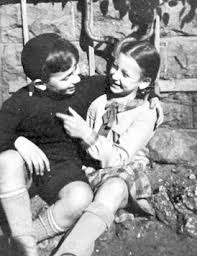
In one of the first videos that I posted on the history of our Shuls, I spoke about the life of Rabbi Hanover z’l- and how he fled Germany as the last Rav of Wurzburg. He sent his youngest daughter, Ruth, to Holland as he and his wife fled to America. Sending for her later, he could not obtain a Visa. His older daughter went to Israel with his stepchildren, Rabbi and Mrs. Hanover were in America, and Ruth never made it out of Holland.
Yehudah Amichai was an Israeli poet. Perhaps Israel’s most famous poet. He was raised Orthodox but became a voice for a religiously skeptical Zionism. Still, among his poems are Jewish thoughts and struggles.
Yehudah was also Ruth Hanover’s childhood friend in Wurzburg when he was known as Ludwig Pfeuffer.
Amichai would write about Ruth at the end of his life, and it was through her that he viewed the Holocaust. According to his girlfriend from his college years, “Amichai had an argument with a childhood friend, Ruth Hanover, which led to her cycling home angrily. Ruth was caught in a traffic accident, as a result of which she had to have a leg amputated and felt guilt and responsibility. Ruth later was murdered in the Holocaust. Amichai referred to her in his poems as “Little Ruth“. (from Wikipedia)
It is possible that her childhood disability complicated her Visa process and led to her being trapped in Europe.
As Amichai carried the picture of Ruth in his heart, Rabbi and Mrs. Hanover carried the guilt of separation with them as they came to these shores until word came that she was deported in 1943 and eventually perished in Sobibor.
With the memory of his daughter and his community in his heart, Rabbi Hanover set out to lead the Shaarei Hatikvah community in Washington Heights.
Analogous to the heavy memories these refugees carried with them, Rabbi Hanover brought something else with him. He brought a stone from the destroyed Shul in Wurtzburg, which he was to embed in the new structure on 179th Street.
It is now some 80 years since that stone was embedded on these shores and that structure is now up for sale. I hope someone will salvage that stone one more time and deliver it to the city of Jerusalem one day soon.
(Much of the content from Yad Vashem)
 schuster's hall