
For my father’s upcoming first Yahrzeit I have begun to record all the family memories and history. I will post tidbits here that relate specifically to his Kehilla and community interactions.
The 1970s and 1980s were a very dark time for New York City. Crime was ever-present. Whole swaths of the city (particularly the Bronx) were filled with abandoned and burnt-out buildings. The subways cars were covered with graffiti inside and out. Drugs, particularly “crack-cocaine”, infested the inner-city. Muggings abounded as well as push-in burglaries. Gangs of teenagers roamed the city at night in a frenzy they called “wilding”. And, most ubiquitous of all, cars were routinely burglarized as they sat parked overnight. People removed their car radios and purchased removable radios called “Benzi Boxes”. Then the car owners would hang a sign in their window stating, “No Radio on Board”. This didn’t always help. One particularly bad month had Grampa’s car robbed three times! The third time the guy was still in the car when Grampa approached it.
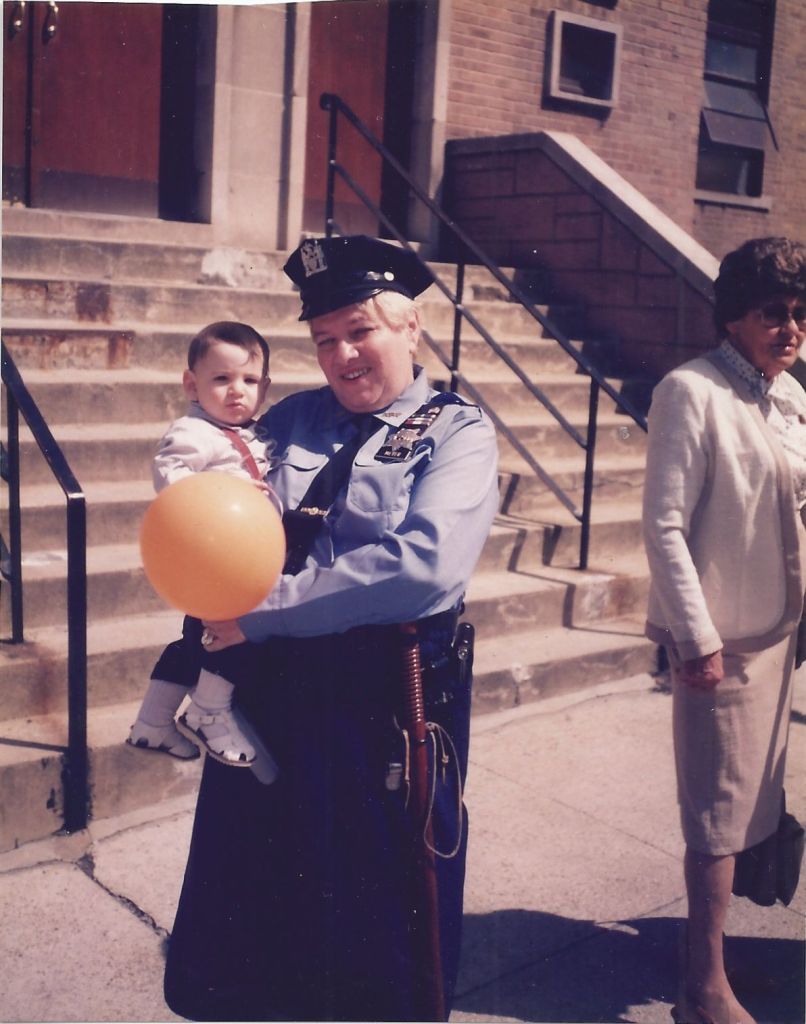
In the height of all this crime, Grandma saw an ad for enrolment in the Auxiliary volunteer corps of the NYPD. She and Grandpa both signed up. She felt that they could help the community improve and that Breuer’s in particular would gain from having a liaison right in the shul. They took their training but not until Grandma was able to secure permission to wear a skirt. Since policewomen had originally only worn skirts, someone in headquarters gave the okay.
From the time they joined, Grampa went out on a twice weekly patrol and Grandma only patrolled at “crowd control” events such as parades and street fairs. The rest of the time she accumulated her hours by volunteering as a typist in the reports room. This was a particularly fun job for Grandma because she had knowledge of what crimes were occurring and in which part of the neighborhood.
Grampa and Grandma’s building was once a very popular Jewish building with a mix of German Jews, YU students and couples, and families affiliated with shuls east of Broadway. By the late 80s it lost much of its Jewish community as crime in the city increased. By the early nineties it was probably time to move out. Grandma wouldn’t move because she was too proud to move down to Bennett Avenue, where she thought the people were too sheltered (perhaps). She felt that if she were to move it would be to Boro Park to start over in a neighborhood that had “all the conveniences”. Grampa, of course, would quicker live in his car than move to Boro Park. So they remained.
Living on the “wrong side of the tracks” had its pitfalls. Loud music from neighbors, including on Shabbos afternoon. Drug deals immediately in front of the apartment windows. People sitting outside at night congregating. Actually, the people congregating was a plus. Muggings in the city often take place on a quiet block in a peaceful neighborhood. Congregating at night is part of Latin American culture where villagers meet in the town square for dominoes and eating after working a full day. These people in front of their buildings were not the criminals but the citizens.
Sometimes, someone from the Breuer’s part of the neighborhood, of the type that lack scruples, would ask my mother why she does not move out of her building. The best way to handle such a blunt question would be a short and humble reply like, “It’s not perfect, but it’s home!” or “We have certain things that you don’t have on Bennett, and we don’t want to give that up!” But Grandma was a proud woman, and she was from the Bronx where the girls had some sass. She would quickly answer with her knowledge of the police reports. “Well, your building isn’t so safe. There were two muggings there and a burglary!” In truth she was right for shutting down intrusive questions and she was right that, ironically, crime was lower in our area- if you didn’t count petty drug peddling.
During their time as auxiliary police officers Grandma and Grampa received several citations (in police and military lingo that is a good thing, it doesn’t mean a traffic ticket) for helping apprehend criminals. Not for chasing them- but by calling or radioing in suspicious activity and license plate numbers or calling for assistance. That is all the auxiliary police is supposed to do. If they would chase criminals, they would need full training and a gun.
On one occasion they got a community member out of trouble. There was someone from Europe living in the community. One day he gets a traffic ticket and explodes at the officer, calling her by the color of her skin. Grampa received a phone call that this person was in a holding cell at the precinct waiting to be booked. Grampa came down and talked to the captain explaining that people in Europe speak that way and are not used to normal race relations. His calm manner and logical way of talking sent this guy home.
Grampa also received recognition for his service on 9/11. He was called that afternoon to help direct traffic off of the West Side Highway, away from ground zero.
As he remained in the auxiliary police Grandma complained to him that he rarely received a promotion. She was probably right that they were avoiding his promotion because there were one or two anti-Semites above him. For instance, occasionally if Yom Tov fell out on his night, he would sign the troupe in, but not close the books until after the Yom Tov. One time that he did this his commanding officer called the house at 2 a.m. and left a message on the machine asking when he will sign out. Haters can’t hide things for long.
As time passed it became inevitable that he receive a promotion. He became auxiliary sergeant, lieutenant, and eventually became the captain. As captain he taught the young troops how to salute and stand for roll call, as well as other formalities good for their discipline. He became a respected figure at the end of his time there.
 schuster's hall